

Amazon Ads confirmed in June 2026 that existing sponsored ads campaigns are automatically eligible to power Alexa for Shopping (Amazon’s conversational shopping assistant, previously known as Rufus) product surfaces.
It has changed how shoppers search for products. They can now ask Alexa for a quiet coffee grinder, compare options, and purchase based on their requirements.
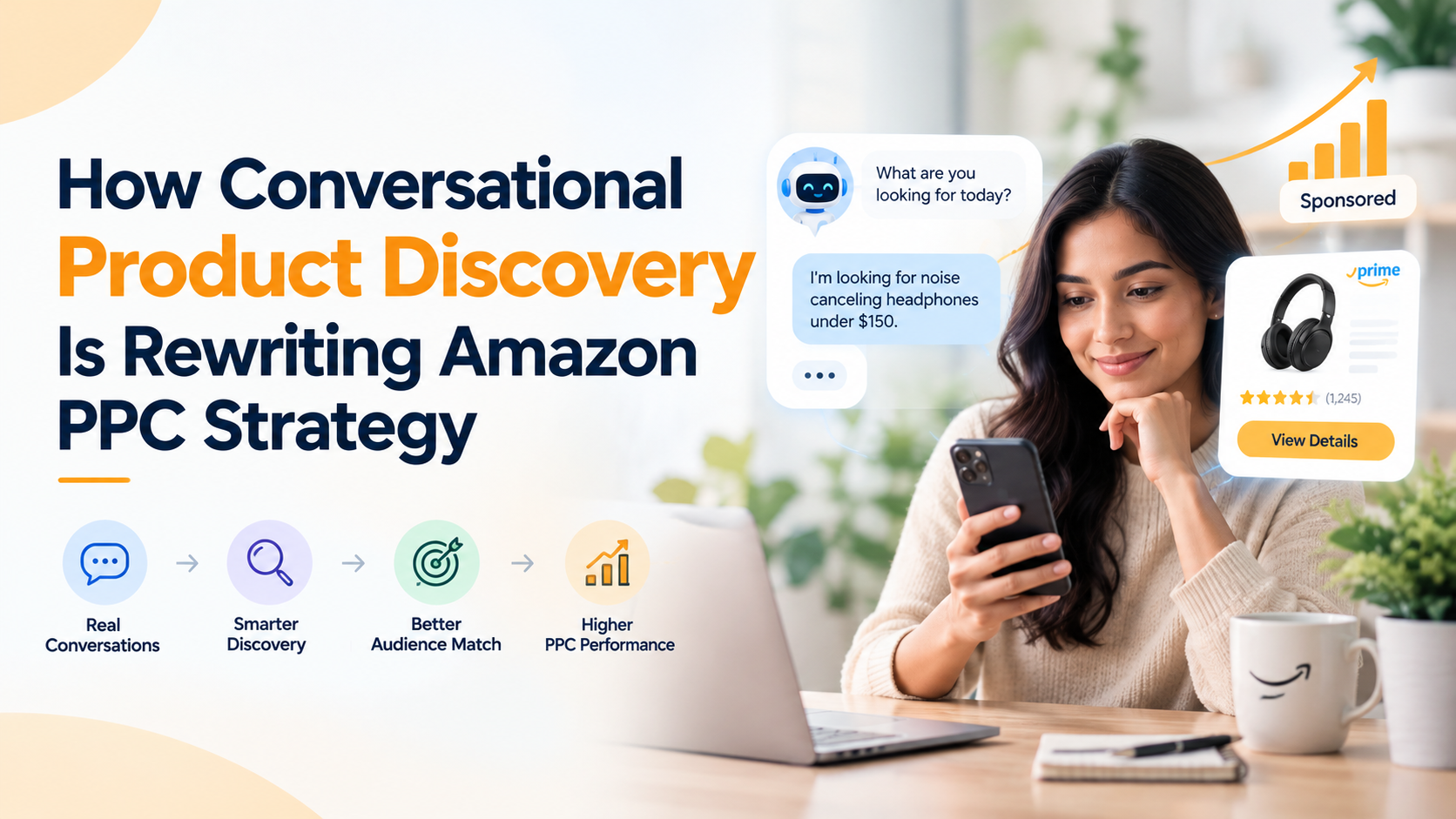
This change reduces advertiser control to some extent. Amazon PPC campaigns built on short, exact-match keywords now compete for intent that shoppers express in full sentences. Sellers must align Amazon PPC with specific purchase intentions while controlling costs.
Product detail pages now also shape ad performance, because Amazon’s conversational ad formats draw on their content. The sections below explain how to adapt your Amazon PPC strategy across keywords, listings, ad formats, and bids.
How Conversational Queries Change Keyword Targeting
Traditional product searches tend to state a product and one attribute, such as “ice blender”. In a conversation, a buyer can ask for a blender that crushes ice for smoothies and fits under a kitchen cabinet.
This request combines a use case, a size limit, and a performance standard. Each detail narrows the shortlist. An assistant built for AI-powered product discovery reads the full request, not a single phrase.
Exact-match keyword lists rarely contain phrasing this specific, so campaigns built only on them likely reach a smaller share of conversational demand. Three adjustments can help close this gap:
- Run phrase-match and broad-match discovery campaigns alongside your exact-match campaigns.
- Review the search term report weekly/monthly (according to your store size) and move converting long-tail terms into exact-match ad groups.
- Add negative keywords for descriptive terms that generate clicks without orders.
Build Campaigns Around Use Cases You Can Actually Target
Conversational questions can help interpret intent, but advertisers cannot assume every question is available as a keyword that they can bid on. Amazon PPC campaign management still depends on keyword and product targeting supported by search-term data.
- Translate shopper needs into searchable terms: For a compact grinder, test relevant combinations such as “small espresso grinder” and “quiet burr grinder,” as long as the product delivers those benefits.
- Protect high-intent traffic: Allocate precise, feature-led terms their own bids and budgets so broad category searches don’t consume spend intended for shoppers closer to buying.
Why Product Detail Pages Now Shape Amazon PPC Performance
Sponsored Products and Sponsored Brands prompts are AI-generated questions that appear on product pages and in search results, respectively.
Amazon’s own example shows a food processor listing with the prompt “How does it perform with dense bread dough?” In its September 2026 announcement, Amazon Ads says the prompt draws content from the brand’s detail pages, Brand Store, and campaign data. Listing content therefore shapes the ad experience itself.
Conversation quality depends on listing data. A listing without motor wattage, bowl capacity, or dough settings gives the shopping assistant less information to work with. Before you raise bids on an ASIN, enrich its product data so that AI systems can interpret it accurately:
- Enrich every required and recommended attribute in the category template.
- Rewrite bullet points to answer use-case questions on fit and compatibility.
- Add A+ comparison charts that explain which product in your catalog suits which need.
How to Match Ad Formats to Conversational Intent
Each sponsored format now serves a different stage of a conversational shopping journey. Sellers must assign budgets by role:
- Amazon Sponsored Products ads handle the purchase stage on product pages. Existing campaigns are automatically eligible to run as prompts, so focus spend on ASINs with complete data and proven conversion rates.
- Amazon Ads reports that nearly 20% of shoppers who interact with a prompt continue the conversation about that brand. According to the same June 2026 update, adding prompts to Amazon Sponsored Brands ads lifts conversions by 6%. Allocate budget to Sponsored Brands campaigns to engage shoppers who are casually browsing products.
- Amazon Sponsored Display ads support re-engagement. Existing campaigns, which the marketplace now groups under its display ads offering, can retarget shoppers who viewed your product detail pages but didn’t purchase.
Each format adds its own reporting workload. Brands with limited in-house capacity often assign search-term and placement analysis to Amazon PPC management specialists.
How Creative Assets Stand Out in Conversational Advertising
Amazon DSP’s responsive eCommerce creative can carry conversational prompts off Amazon through a different advertising setup. A useful creative test is whether the ad shows a distinction shoppers can verify.
Running Wolf’s Rant recently examined how excessive digital marketing optimization can make brands less memorable. This concern also applies to Sponsored Brands creative when every competitor makes the same broad claims; the ad needs to highlight specific product features, benefits, or differentiators that shoppers can recognize and compare.
A Conversational Readiness Audit to Test Your Amazon PPC Strategy
Run this audit monthly to keep Amazon paid ads management aligned with how shoppers now find products:
- Check that your 20 highest-spend ASINs have complete attributes, use-case bullets, and A+ content (where applicable).
- Compare 30-day orders from exact-match campaigns with orders from phrase-match and broad-match campaigns.
- Extract recurring questions from reviews and return reasons, and confirm that each detail page answers them.
- Track ACoS and TACoS by ASIN monthly to check whether discovery and prompt spend adds incremental sales.
Test a Small Product Group Before Reallocating Budget
Start with a small product group whose specifications clearly support a conversational use case. Update its listings, introduce a well-defined keyword cluster, and compare results against similar, unchanged products over time.
When conversions vary consistently by time, dayparting strategies for Amazon PPC campaigns may help allocate budget to stronger selling hours. Validate those patterns before applying scheduling rules.
Effective Amazon paid ads management requires ads that match shoppers’ specific intent and lead to credible product detail pages.
Brands that adapt now can protect margins because more ad clicks land on product pages that already answer the shopper’s question. The outcome will depend on Amazon PPC campaign management that connects listing data, creative, and bidding decisions.
Watch this space for updates in the Hacks category on Running Wolf’s Rant.
Want to promote your business, event, product or service? We get more than 14,000 pageviews a month! Contact us for marketing and advertising options.